
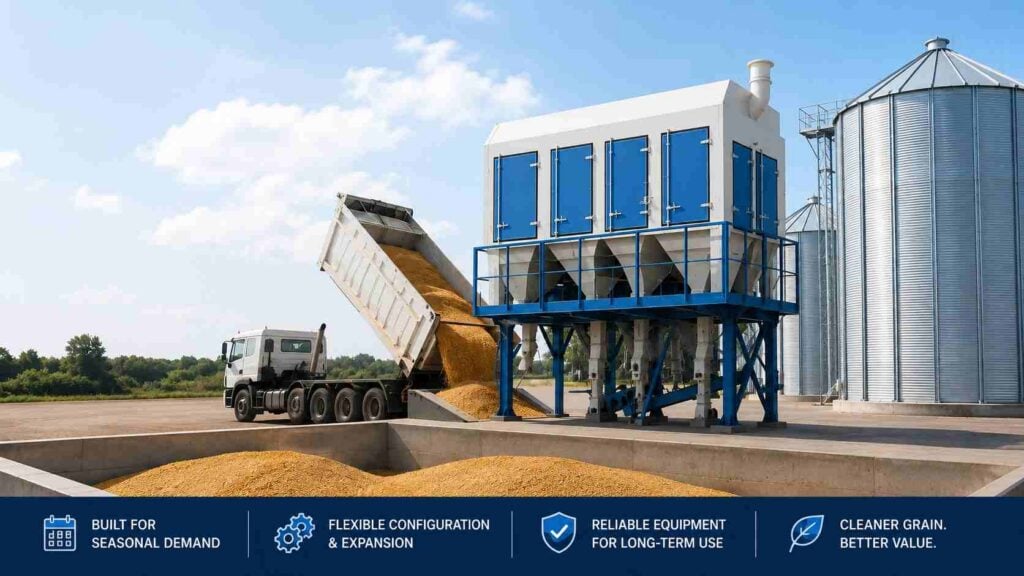
Seasonal grain collection stations operate differently from permanent grain handling plants. During harvest, trucks and trailers often arrive in concentrated periods, so the receiving system must unload, pre-clean, and transfer grain fast enough to avoid long queues.
For this reason, equipment should not be selected only by the rated capacity of a grain pre-cleaner. Receiving, feeding, pre-cleaning, conveying, dust control, and discharge all need to work as one system.
The starting point is therefore not the machine itself, but the peak receiving demand of the station.
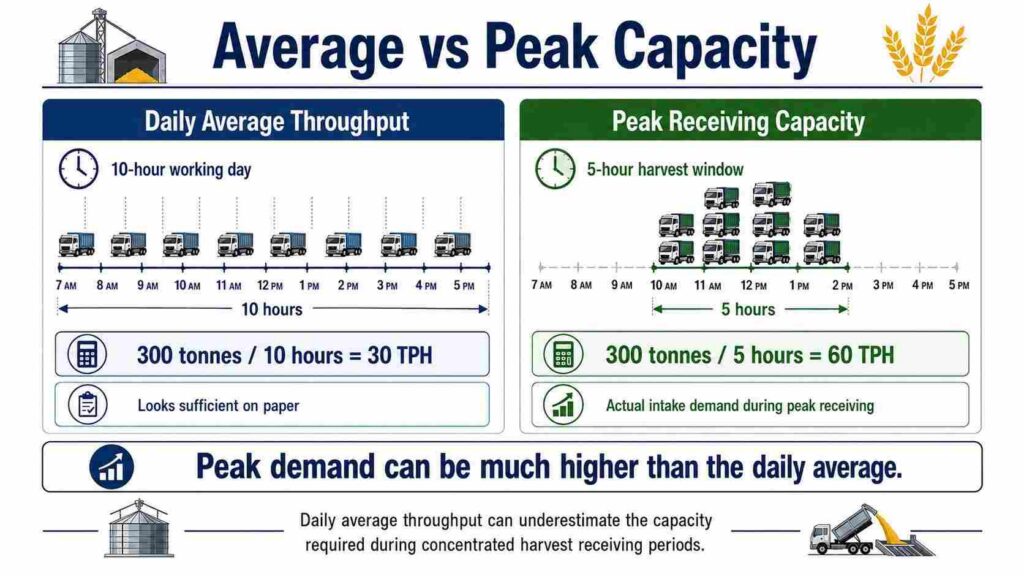
Size the System for Peak Receiving Capacity, Not Daily Average Throughput
Daily throughput can be misleading when sizing a seasonal grain receiving system.
For example, a station expecting 300 tonnes during a 10-hour working day may appear to require only 30 TPH. But if most trucks arrive within a five-hour harvest window, the actual receiving demand may be closer to 60 TPH.
Several trucks arriving at the same time can create an even higher short-term load. If the system cannot keep up, queues form quickly and unloading slows down.
Before deciding the required capacity, consider:
- how many trucks may arrive during the busiest hour;
- typical load per vehicle;
- required unloading time;
- whether a receiving hopper can buffer incoming grain;
- whether feeding and discharge equipment can maintain continuous flow.
The complete line is only as fast as its slowest component.
An 80 TPH pre-cleaner paired with a 50 TPH feeding conveyor will still leave the complete system operating at roughly the lower capacity.
Practical throughput can also vary with impurity level, moisture, and feeding consistency. For seasonal collection stations, it is therefore safer to size the line around the peak truck receiving pattern and then match the main components with a reasonable operating margin.
Choose the Right Grain Receiving Method
The receiving method should match how grain arrives, how often the station operates, and how much site infrastructure is available.
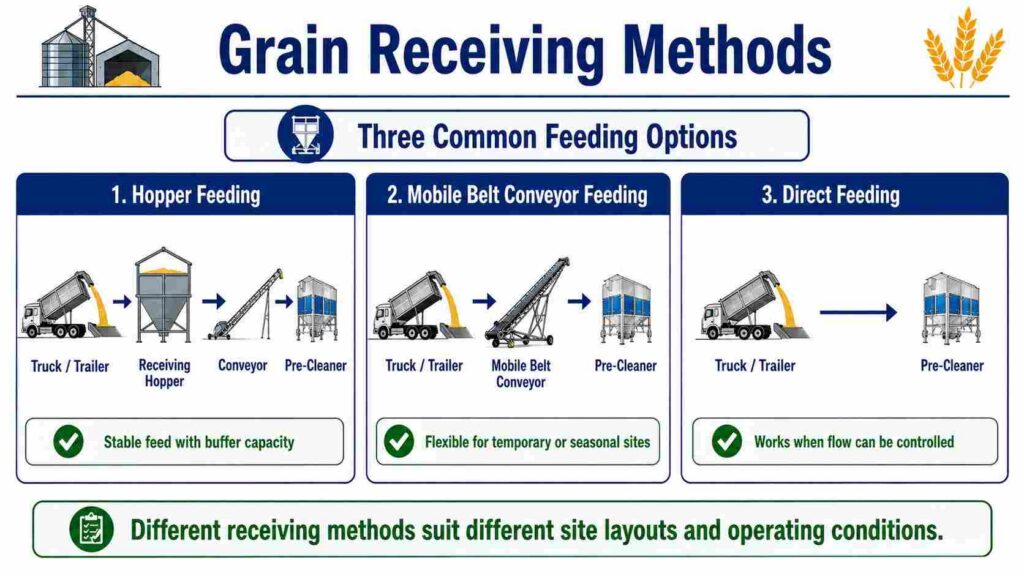
For a fixed collection point, a common arrangement is:
Truck or Trailer → Receiving Hopper → Feeding Conveyor → Pre-Cleaner
The receiving hopper provides temporary buffer capacity and helps smooth out uneven unloading. This is useful when several trucks arrive close together or when the downstream pre-cleaner needs a stable feed rate.
At temporary or seasonal sites, a mobile feeding conveyor can often replace a permanent receiving pit or large hopper.
A typical arrangement is:
Truck or Trailer → Mobile Feeding Conveyor → Pre-Cleaner → Discharge Conveyor
This reduces civil construction and makes it easier to reposition the equipment when the collection point changes.
Direct feeding into a pre-cleaner may also be possible, but only when the incoming flow can be controlled. Sudden surges can overload the screen and create unstable discharge.
In practice, stable feeding is often more important than simply selecting a higher-capacity cleaner.
Mobile vs. Fixed Grain Receiving Systems: Which Fits Your Operation?
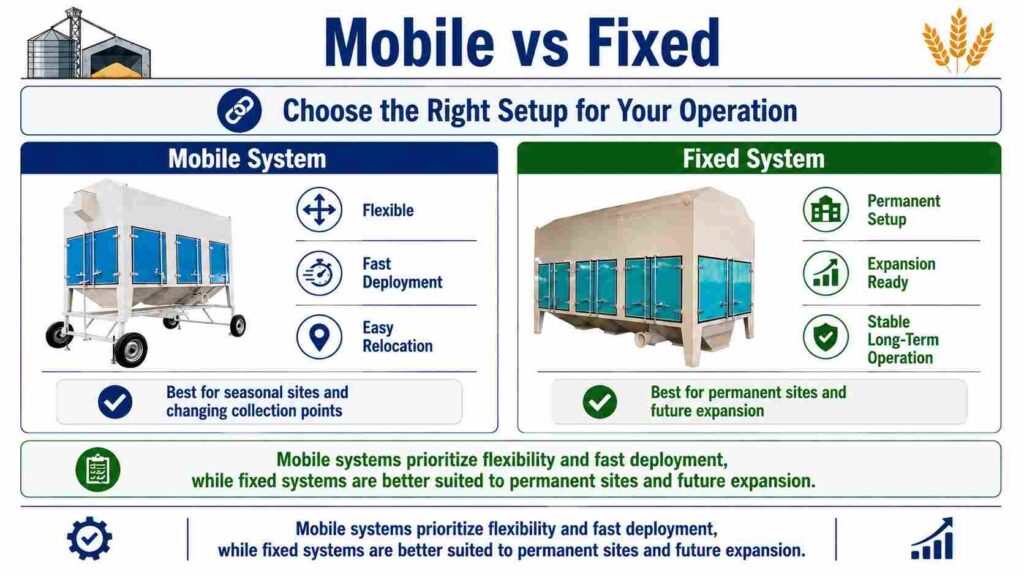
A mobile system is usually more practical when the station operates only during harvest, serves several collection points, or needs fast installation with limited civil work.
It can also reduce the risk of investing heavily in permanent infrastructure before annual grain volume is fully established.
A fixed grain receiving system is more suitable when the site operates for longer periods, transfers grain directly into warehouses or silos, or requires a more automated process.
It also provides a better base for future additions such as bucket elevators, storage bins, dust collection, or downstream cleaning equipment.
The choice should therefore depend on the operating model rather than equipment preference alone.
If the equipment must move between sites, flexibility and quick setup usually matter more. If the station will remain in one location and expand over time, a fixed layout may provide better long-term efficiency.
Define What Pre-Cleaning Must Achieve Before Storage or Transfer
At a seasonal collection station, pre-cleaning is mainly used to remove coarse and light impurities before grain moves into storage, reloading, or further processing.
Typical impurities may include: straw and stalks; leaves and husks; large foreign materials; chaff and light dust.
Removing these materials early improves grain flow and reduces the amount of unwanted material carried through the rest of the handling system.
This can help reduce blockage at transfer points, lower the dust load, and avoid using conveyor or storage capacity to move material that should have been removed at intake.
Pre-cleaning should not be confused with fine cleaning or seed grading. Its purpose is to protect downstream handling and prepare bulk grain for the next stage.
The exact screen opening and aspiration setting should still be selected according to grain size, impurity profile, and required capacity. Crop-specific sieve selection is better handled separately for wheat, corn, soybean, and other grains.
Design Conveying Around the Cleaner, Not After It
A grain pre-cleaner cannot perform well if the feeding and discharge system cannot keep pace with it.
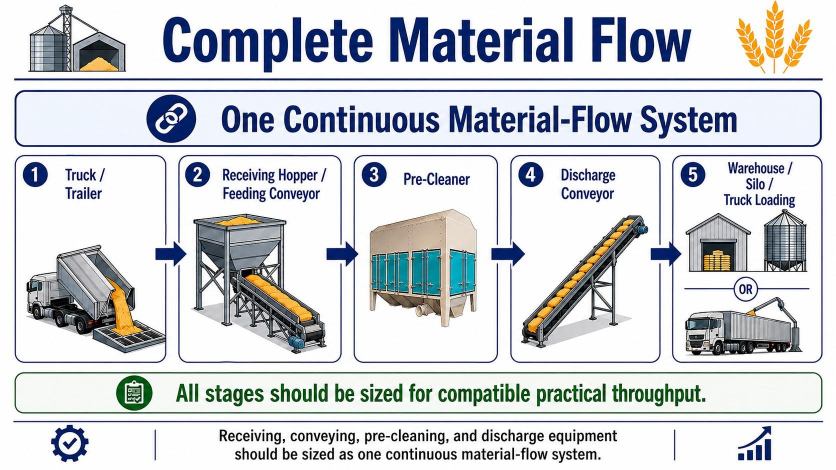
A typical material flow may look like:
Truck / Trailer → Receiving Hopper or Feeding Conveyor → Pre-Cleaner → Discharge Conveyor → Warehouse, Silo, or Truck
Each stage should support the same practical throughput.
Even when the pre-cleaner has sufficient capacity, an undersized feeding or discharge conveyor can still restrict the entire line.
Conveyor layout also affects how smoothly the system operates.
Transfer points should minimize spillage, while discharge height and conveyor direction should match the final destination. Where grain damage matters, excessive drop height should also be avoided.
The pre-cleaner, conveyors, and discharge point should therefore be treated as one material-flow system rather than as separate machines.
This prevents a high-capacity machine from being limited by a smaller component placed before or after it.
Match Dust Control to Your Grain Receiving Environment
Dust control should be planned according to where and how the station operates.
For outdoor seasonal receiving, a simple aspiration system or cyclone may be sufficient when the main goal is to remove chaff, husks, and light impurities from the grain stream.
Indoor receiving usually requires more attention. Dust released at unloading, screening, and transfer points can affect housekeeping, visibility, and downstream equipment.
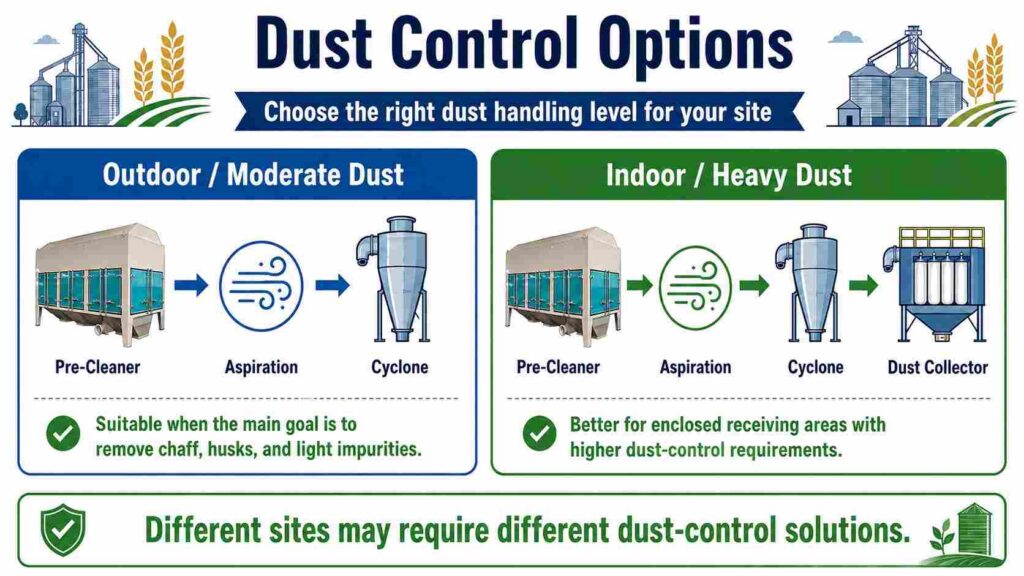
A more complete arrangement may include:
Pre-Cleaner Aspiration → Cyclone → Dust Collector
The required level depends on grain condition, dust concentration, local environmental requirements, and the number of transfer points.
Dust equipment should be considered during the initial layout because ducts, cyclones, collectors, and discharge points all require installation space.
Build a Scalable Grain Receiving System for Future Expansion
A seasonal collection station does not need to install every processing stage from the beginning.
A practical first-stage system may consist of:
Receiving → Conveying → Pre-Cleaning → Storage or Loading
As grain volume increases or quality requirements become stricter, additional equipment can be added.
Possible future stages include: aspiration upgrades; destoning; fine cleaning; magnetic separation; bucket elevators; silos or storage bins; weighing and packing equipment.
The important point is to reserve enough space and suitable connection points before expansion becomes necessary.
Discharge height, conveyor direction, electrical capacity, and maintenance access should all allow later additions without rebuilding the complete grain receiving system.
This is what makes the system genuinely scalable: the first stage solves the current receiving problem while leaving room for the next stage.
Confirm Site Conditions Before Finalizing the System
Before finalizing the layout, check whether the system fits the actual site and seasonal operating conditions.
Key factors include available space and height, power supply, ground or foundation conditions, truck unloading method, outdoor weather protection, maintenance access, and the destination after pre-cleaning.
For seasonal operations, also consider how easily the equipment can be dismantled, relocated, stored, and restarted for the next harvest.
Screens, belts, bearings, and other common service parts should be inspected before the receiving season begins to reduce avoidable downtime.
A practical layout should fit the site, remain easy to access and maintain, and support reliable operation during the busiest harvest period.
FAQs:
1. How can I verify the actual capacity with my grain?
Rated capacity can vary with grain type, moisture, bulk density, impurity level, screen opening, and feeding stability. Before finalizing the system, provide representative grain information, impurity photos, or samples when possible. Material testing can also help confirm screen configuration and expected practical throughput.
2. Can one system handle different grains?
Yes, but one setup may not suit every crop. Wheat, corn, soybean, and barley differ in size, density, flow behavior, and impurity profile. The same machine may be used, while screens, aspiration settings, operating parameters, and expected capacity may need adjustment.
3. Can a pre-cleaner be added to an existing receiving line?
Often yes. The key is checking whether the existing conveyors, inlet and outlet heights, available space, power supply, and dust connections are compatible. A process flow, equipment photos, and site dimensions help identify potential integration problems before installation.
4. Is one large receiving line always better than two smaller lines?
Not necessarily. One larger line may simplify operation and reduce equipment quantity, while parallel lines can provide more flexibility during maintenance or changing receiving volumes. The better choice depends on peak capacity, site layout, operating hours, redundancy requirements, and future expansion plans.
5. How can I reduce downtime during the harvest season?
Prepare before the receiving season begins. Inspect screens, belts, bearings, seals, and other common service parts, and make sure operators understand cleaning, lubrication, and adjustment procedures. For imported equipment, keeping recommended wearing parts on site can reduce delays if replacements are needed.
6. What should be checked before the equipment is shipped?
For a project-critical receiving system, confirm machine configuration, screen specifications, motor and electrical requirements, rotation direction, key dimensions, and connection points before shipment. A factory test and operating video can also help identify issues before the equipment reaches the site, where modifications are usually more difficult and costly.
Conclusion — Design for the Harvest Peak, Then Expand as Needed
A scalable grain receiving and pre-cleaning system should be designed around how your station actually operates during the harvest season.
Start with the peak receiving demand, then make sure the hopper, feeding equipment, pre-cleaner, discharge conveyor, and dust-control system can work together at compatible capacities.
For seasonal projects, a simpler first-stage system is often more practical than installing equipment for future requirements that may not yet exist. The priority is to handle current grain intake efficiently while leaving enough space, capacity, and connection points for later expansion.
As receiving volumes grow, the system can be extended with additional cleaning, conveying, storage, or packing equipment without redesigning the entire layout.
Plan Your Grain Receiving System Around Real Site Conditions
Every collection station has different intake patterns, site conditions, and storage requirements.
Share your peak receiving capacity, grain type, truck unloading method, available site dimensions, and final grain destination with us. We can help you evaluate a practical receiving, conveying, and pre-cleaning layout based on your actual operating conditions.