
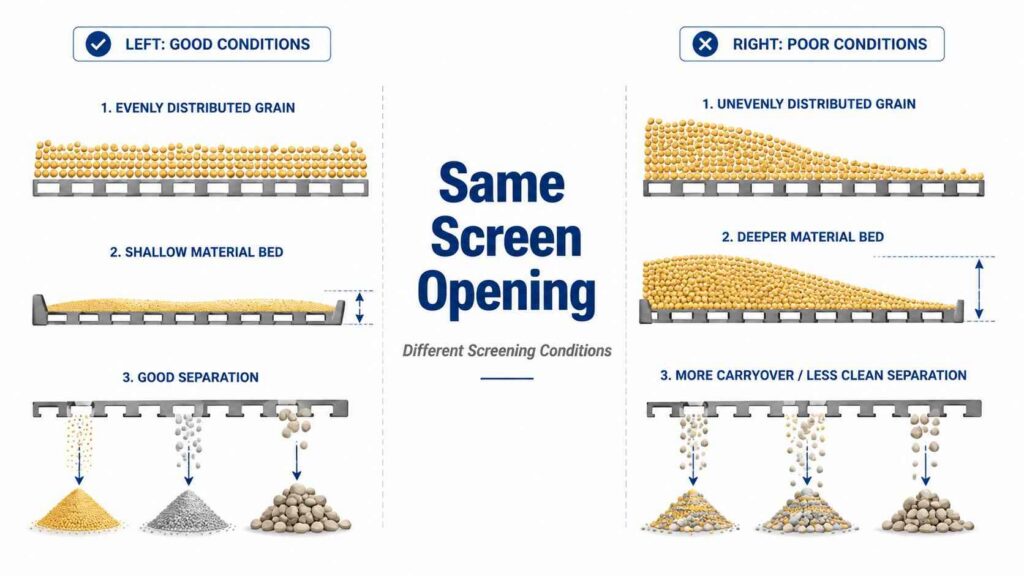
When you compare grain cleaners for a wheat, maize, soybean, or seed processing project, screen opening size is often one of the first specifications you look at. It is important, but it does not fully explain how the machine will perform.
Two grain cleaners can use the same or similar screen openings and still deliver different capacity, impurity removal, and grain loss. The opening defines the basic separation boundary, but actual grain screening efficiency also depends on how much usable screen area is available and how effectively the grain reaches and moves across it.
So the key question is not only what screen opening should be used, but also how easily the grain can reach that opening and pass through it. This distinction becomes important when you compare machine capacity and cleaning results under different operating conditions.
For broader post-harvest context, the FAO guidance on grain cleaning describes cleaning as an important step for removing impurities before storage, marketing, further processing, or artificial drying.
Screen Opening Defines the Size Separation Boundary
Screen opening size determines which particles can theoretically pass through the screen and which should remain on the screen surface. In grain cleaning, this provides the basic separation boundary between the desired grain and size-based impurities.
However, a correctly selected opening does not automatically produce effective screening. The grain must reach the screen surface, encounter the openings, and have enough opportunity to pass through them.
This becomes more important when the grain and impurities have similar dimensions. If an impurity is close to the selected opening size, its separation may depend heavily on screen motion, material distribution, and residence time rather than opening size alone.
For this reason, screen opening should be treated as the starting point for screen selection, not as a complete measure of grain screening efficiency.
Open Area Determines How Much Passage Is Available
Two screens can have the same nominal opening size but different open areas. Hole spacing, perforation pattern, bridge width, and hole shape all affect how much of the screen surface is actually available for material to pass through.
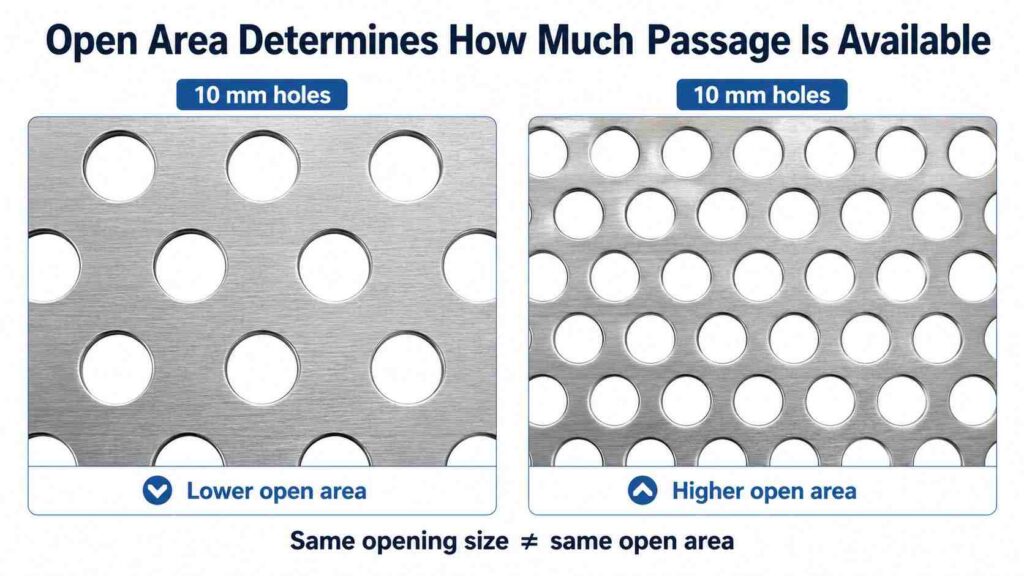
A higher open area generally provides more passage for grain and can support higher throughput, provided the screen still has sufficient strength and durability for the application. However, increasing open area is not simply a matter of making the holes larger or placing them closer together.
The screen must maintain adequate strength, wear resistance, and structural stability under continuous operation. This means screen opening alone is not enough for comparison; what matters is how much effective passage area the screen provides under real operating conditions.
Even then, that area can only work well if the grain is distributed evenly across the screen.
Grain Distribution Determines How Much of the Screen Is Really Working
A large screening area does not automatically mean a large effective screening area. If the grain enters the machine unevenly, some parts of the screen may receive too much material while other sections remain underused.
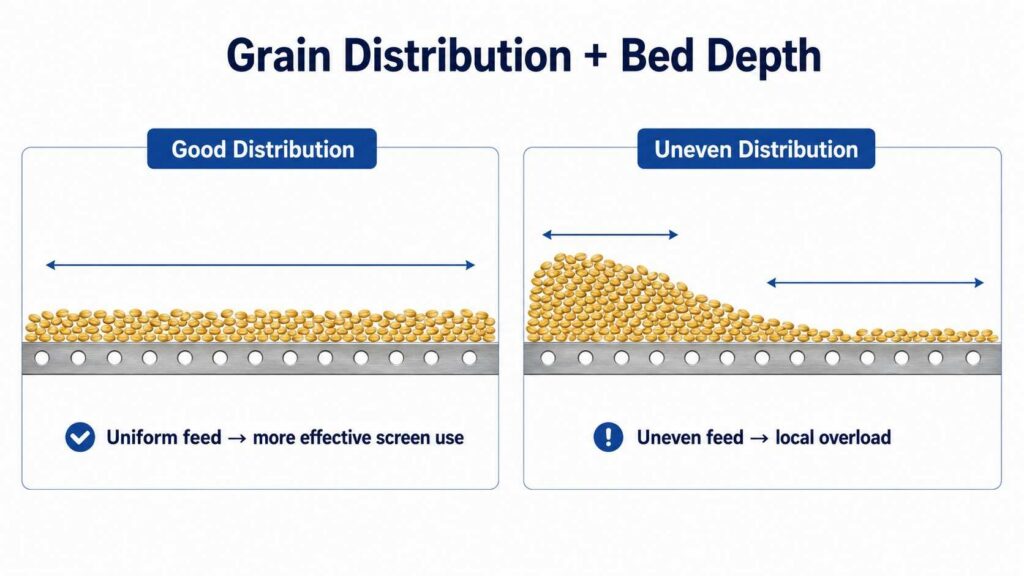
An unstable feed from an elevator, conveyor, hopper, or batch feeding point can create local accumulation. The overloaded area develops a deeper grain layer, while other parts of the screen contribute less to the separation process.
A suitable distributor, feed roller, gate, or buffer hopper can help spread the material more evenly. More uniform distribution allows a larger portion of the screen surface to participate in separation and reduces local overloading.
This is particularly important when the machine is operated close to its rated capacity, because uneven feeding can reduce effective screening capacity even when the total screen area appears sufficient.
Material Bed Depth Controls Whether Grain Can Reach the Screen
Once grain is distributed across the screen, bed depth affects how easily smaller grain and undersized impurities can reach the screen surface.
A controlled and reasonably shallow grain bed gives smaller particles more opportunities to reach the openings, while a deeper bed can reduce screen contact and lower grain screening efficiency, especially as feed rate increases.
For this reason, grain cleaner capacity should be evaluated not only by TPH, but also by whether the machine can maintain a suitable grain bed and cleaning result under actual operating conditions.
Screen Motion Changes the Way Grain Contacts the Screen
The movement of the screen or screening surface changes how the grain spreads, contacts the openings, and travels through the machine.
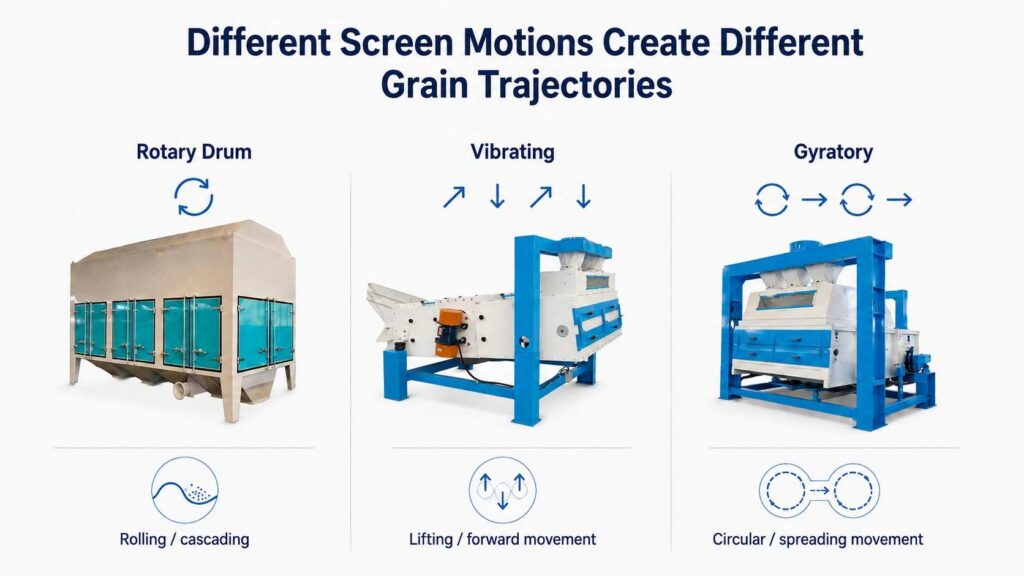
In a rotary drum cleaner, the rotating drum lifts and rolls the grain as it moves forward. The material repeatedly contacts the perforated surface, making this type of cleaner suitable for continuous pre-cleaning and removal of coarse impurities. For example, a single or double drum rotary pre-cleaner can be used at the intake stage before further grain cleaning.
A vibrating grain cleaner uses controlled vibration to move and spread the material across the screen. Its motion can provide more controlled contact between the grain and the screening surface.
A gyratory or planar rotary cleaner uses a controlled circular or elliptical movement. This can help distribute the grain across the screen and provide repeated opportunities for size separation.
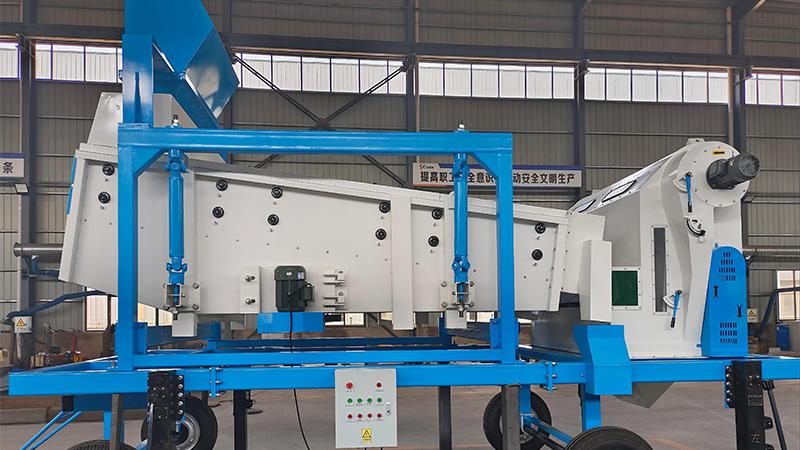
Therefore, a 10 mm screen opening in a rotary drum cleaner can perform differently from the same opening in a vibrating or gyratory grain cleaner. The opening may be identical, but the way the grain interacts with the screen is different.
Residence Time Determines How Many Separation Chances the Grain Gets
Screening is not an instantaneous process. Grain needs enough time on the screening surface for smaller particles to reach and pass through the openings.
If the material moves too quickly, some particles may leave the screen before they have enough opportunities to pass through. This can increase carryover and reduce the final cleaning result.
However, simply increasing residence time is not always better. Excessively slow material movement can reduce throughput and may not provide a practical operating advantage.
The objective is to provide enough residence time for effective separation while maintaining the required capacity.
Incoming Impurities Change the Screening Duty
The same grain cleaner capacity can represent very different screening loads depending on the condition of the incoming material.
High impurity levels increase the screening load by occupying more screen area, disturbing grain flow, increasing reject volume, and raising the risk of blockage. Large straw, cob pieces, stones, husk, broken grain, and fine particles can also place different demands on the screening system.
This is why the cleaning duty matters when you evaluate a grain cleaner. A machine used for heavy pre-cleaning may have a different screening requirement from one used for fine cleaning or final grading.
The FAO grain cleaning guidance also notes the importance of removing impurities before storage, marketing, further processing, and artificial drying. The actual impurity condition therefore needs to be considered together with the cleaning stage and machine capacity.
Moisture and Material Condition Can Change Screening Behavior
Moisture can change how grain and impurities move across a screen. Dry, free-flowing material generally moves more easily, while damp or sticky material can increase adhesion and reduce smooth movement across the screening surface.
When material sticks to the screen or blocks openings, the effective open area becomes smaller. This can reduce screening efficiency even though the nominal screen opening has not changed.
Moisture can also affect the flow behavior of different materials differently. For this reason, the condition of the incoming grain should be considered when evaluating expected screening performance.
FAO post-harvest guidance also treats moisture as an important quality factor that needs to be monitored during grain handling and storage. FAO’s grain monitoring guidance provides further background on impurity and moisture assessment.
Why Capacity and Screening Efficiency Must Be Evaluated Together
A grain cleaner’s rated capacity is normally expressed in TPH, but this number alone does not tell you the expected cleaning result.
A machine may handle a certain throughput mechanically while the actual cleaning efficiency decreases when the feed rate becomes too high. As throughput increases, the material layer can become deeper, residence time can decrease, and the available screen area may become less effective.
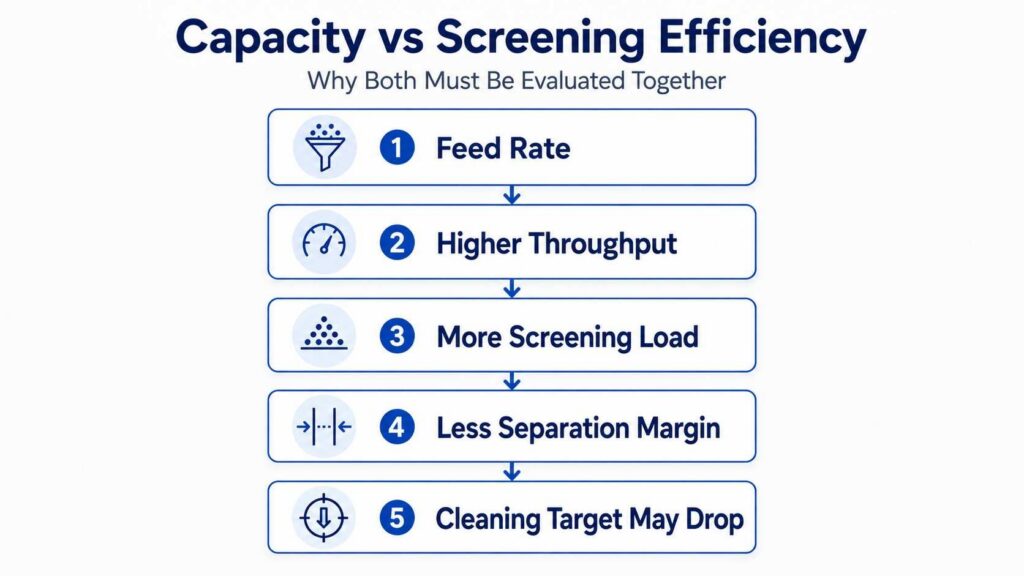
There is also an important difference between maximum capacity and useful operating capacity. A supplier’s stated capacity may assume a particular grain, moisture condition, impurity level, and cleaning duty.
When you compare grain cleaners, therefore, look at the expected cleaning result at the operating capacity you actually need. A realistic evaluation should consider the material condition and screening duty rather than comparing TPH figures alone.
A Practical Grain Cleaning Example: Same Screen Opening, Different Result
Consider two wheat cleaning situations using a similar screen opening.
In the first situation, the wheat is relatively dry and contains a moderate amount of impurities. The feed is stable, the grain is distributed evenly, and the material layer remains reasonably shallow. Under these conditions, a large portion of the screen surface can contribute to separation.
In the second situation, the wheat contains more straw and other impurities, the moisture is higher, and the feed is less stable. The same screen opening may still be technically suitable, but the thicker material layer, uneven distribution, and reduced effective open area can lead to more carryover and a lower cleaning result.
The difference does not necessarily come from the screen opening itself. It comes from the screening conditions surrounding that opening.
This is why a grain cleaner should be evaluated as a complete screening system rather than by one specification.
Conclusion — Screen Opening Is Only the Starting Point
Screen opening defines what grain or impurities can theoretically pass, but it does not determine the final cleaning result. Actual screening efficiency depends on how the material reaches and moves across the screen, and whether enough separation can occur at the required throughput.
When you compare grain cleaners, the more reliable basis is your crop, impurity condition, cleaning target, and required capacity, not screen opening alone.
FAQ
Should screen opening be selected based on grain size or impurity size?
Both matter. Grain size shows what should stay or pass through the screen, while impurity size shows what needs to be removed. The right screen opening should match both.
Can the same screen configuration be used for wheat, maize, and soybean?
Usually not. Wheat, maize, and soybean have different sizes, shapes, impurities, and flow behavior, so the screen configuration may need to change.
Is a larger screening area always better?
Not always. A larger screen helps only when the grain is spread evenly and the screen area is used effectively.
When should aspiration be added instead of relying only on screens?
Screens mainly separate by size. If the grain contains dust, husk, chaff, or other light impurities, aspiration is often needed to remove them by airflow.
When should a rotary drum, vibrating, or gyratory grain cleaner be considered?
It depends on the impurity type, capacity, cleaning target, and material condition. A rotary drum cleaner is often used for heavy pre-cleaning, while vibrating and gyratory cleaners are better for more controlled cleaning and grading duties.
Need Help Evaluating the Right Screening Conditions for Your Grain?
Selecting a grain cleaner should start with the actual material, not only the screen opening or rated capacity.
If you are planning a wheat, maize, soybean, seed, or other grain cleaning project, please tell us what material you are processing, the required capacity, the main impurities and their approximate level, the moisture condition, and the cleaning result you need to achieve.
With this information, we can evaluate a suitable screen configuration and machine type, and give you a more realistic estimate of the operating capacity for your application. If you would like to discuss your project with our technical team, please contact us with these details