
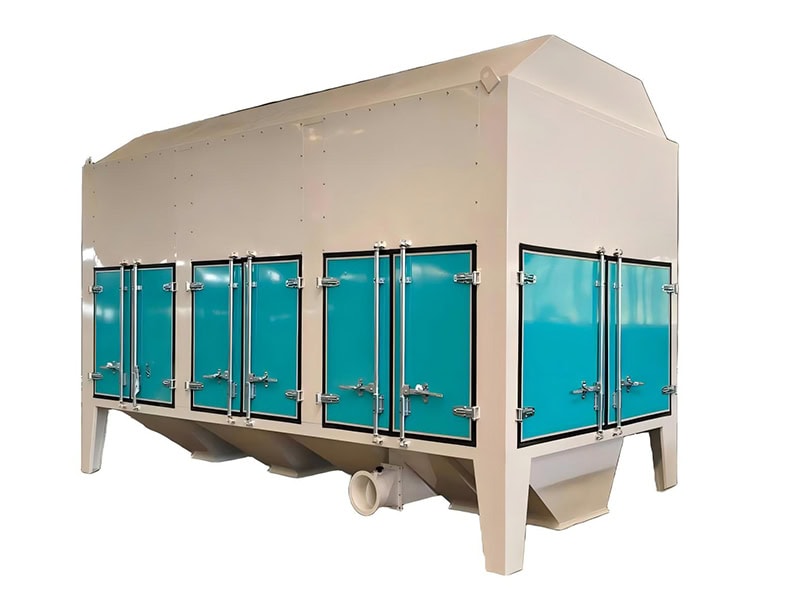
A rotary drum pre-cleaner works mainly by size separation: grain passes through selected screen openings while larger impurities continue to a separate outlet. Its actual performance depends not only on screen size, but also on feed rate, material flowability, moisture, and impurity condition.
In grain receiving, the first cleaning step is often not about producing a finished clean product. The priority is to remove coarse impurities before they create problems in conveying, drying, storage, or further processing.
A rotary drum pre-cleaner is designed for this stage. It handles a continuous flow of raw grain and separates oversized foreign material through a rotating screened drum. Depending on the machine configuration, smaller impurities can also be removed through an additional screening section.
What Is a Rotary Drum Pre-Cleaner?
A rotary drum pre-cleaner is a screening machine used to remove coarse impurities from grain before drying, storage, or further cleaning. It is mainly used for pre-cleaning rather than fine cleaning, with the purpose of reducing the impurity load before grain enters downstream equipment.
Raw material enters a rotating cylindrical drum fitted with perforated screens. As the drum turns, grain moves continuously across the screen surface. Material small enough to pass through the selected openings is separated from oversized impurities such as straw, sticks, corn cobs, leaves, and large clods.
Typical process positions include:
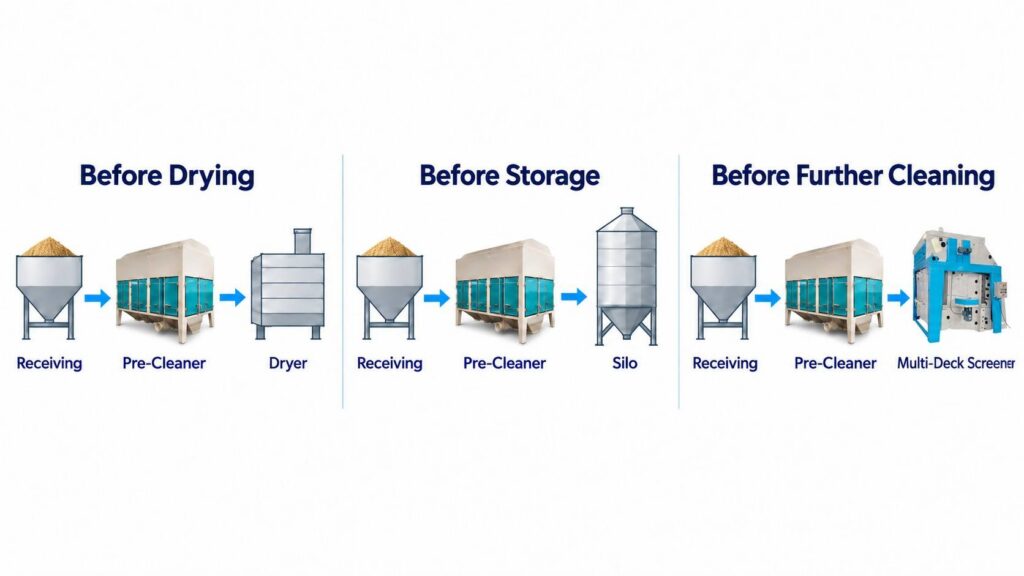
Grain receiving → Rotary drum pre-cleaner → Dryer
Grain receiving → Rotary drum pre-cleaner → Storage silo
Where a higher final cleaning standard is required, the drum pre-cleaner is usually followed by more selective cleaning equipment.
Typical Applications in Grain Handling Systems
Rotary drum pre-cleaners are commonly used where large volumes of raw grain arrive continuously and contain noticeable amounts of coarse foreign material.
Typical applications include grain collection stations, silo intake systems, maize receiving lines, feed mills, flour mills, oilseed plants, and drying facilities.
For seasonal receiving stations or high-capacity intake systems, the pre-cleaner is normally integrated with feeding conveyors, elevators, discharge conveyors, and dust collection equipment as part of the complete grain receiving and pre-cleaning system.
How Does a Rotary Drum Pre-Cleaner Work?
A rotary drum pre-cleaner separates grain and foreign material mainly by particle size.
As the drum rotates, the incoming material is spread, turned, and moved forward across the screen surface. Grain and smaller particles pass through selected openings, while oversized impurities remain inside the drum and discharge separately.
Feeding and Material Distribution
Raw grain enters the drum through the inlet and begins moving with the rotating screen.
The rotation lifts and redistributes the material as it travels forward. This repeated movement gives more grain a chance to contact the screen surface instead of allowing the full flow to pass through as one compact mass.
Stable feeding is important. A sudden or uneven feed can create a deeper material layer and reduce effective screening.
Screening by Particle Size
The screen opening defines the basic separation boundary.
Material smaller than the opening can pass through the screen, while larger impurities remain above it.
In coarse grain pre-cleaning, this principle is commonly used to separate straw, sticks, corn cobs, leaves, stalks, large clods, and other oversized foreign material.
The grain needs enough clearance to pass reliably, while the unwanted oversize material must remain above the screen.
Separate Discharge of Grain and Oversized Impurities
After passing through the screen, the grain leaves through a separate outlet.
Oversized impurities continue moving along the drum until they reach the impurity discharge end. This allows continuous separation without interrupting the grain flow.
On double-drum or multi-stage designs, different screen sections can create more than one size-based separation step, allowing coarse and smaller impurities to discharge separately.
| Screening arrangement | Best suited for | Typical separation duty |
| Single drum | Coarse pre-cleaning | Separating grain from straw, sticks, cobs, stalks, and other oversized material |
| Double drum | More than one size-based separation | Removing oversized impurities while also separating smaller impurities or fines |
What Can a Rotary Drum Pre-Cleaner Remove?
A rotary drum pre-cleaner is most effective when the unwanted material differs clearly from the grain in size.
Its main strength is coarse separation. It does not replace equipment that separates material by density, aerodynamic properties, or color.
Oversized Impurities
Large foreign material is the main target of rotary drum pre-cleaning. With a suitable screen opening, grain passes through the screen while larger impurities such as long straw, cobs, sticks, and other bulky material remain inside the drum and move toward the oversize outlet, preventing them from interfering with conveyors, elevators, dryers, and storage equipment.
Small Impurities and Fines
Smaller impurities can also be removed when the machine includes an additional screening section with suitable openings. This may include broken particles, sand-sized material, and other fines smaller than the grain, with the achievable separation depending on the screen arrangement and the size difference between the grain and the impurities.
Dust and Light Impurities
During drum screening, dust, husk, chaff, and other light material can become airborne inside the enclosed machine. These particles are normally extracted through aspiration points in the drum housing and carried into an external dust collection system.
For high-capacity pre-cleaning, a common arrangement is:
Rotary drum pre-cleaner → Cyclone → Pulse bag dust collector
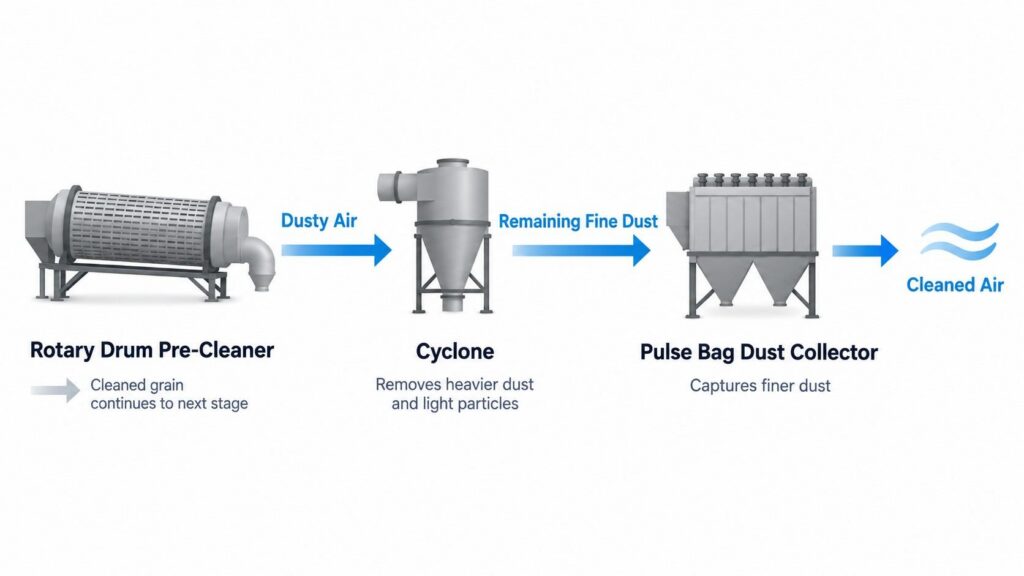
The cyclone removes a large share of the heavier dust and light particles from the air stream. The pulse bag dust collector then captures finer dust before the air is discharged.
This type of dust extraction is different from a curtain-type air aspirator.
A waterfall or curtain aspirator works best when grain is first spread into a thin, uniform falling curtain so that airflow can pass evenly through the material. This condition is easier to create after a vibrating or planar screen, or through a dedicated feeding and distribution section.
For a conventional high-capacity rotary drum pre-cleaner, extracting dusty air from the enclosed drum and treating it through a cyclone and pulse bag dust collector is usually the more practical arrangement.
What the Drum Cannot Remove Effectively
Some impurities cannot be separated well by screen size alone.
If stones are close to the grain in size, a destoner is usually more suitable. Shriveled, immature, or low-density grain may require a gravity separator. Color defects, mold spots, or discolored kernels require optical sorting.
A rotary drum pre-cleaner should therefore be treated as the first cleaning stage rather than a complete cleaning system.
What Affects Rotary Drum Pre-Cleaning Performance?
Nominal capacity does not tell the whole story. Actual rotary drum pre-cleaning performance depends on screen opening, feed rate, bed depth, moisture, material flowability, and impurity condition. A machine may still handle the required throughput while delivering a lower cleaning efficiency if these operating factors are not properly matched to the material.
Screen Opening and Effective Screening Area
The screen opening determines what can pass through and what remains as oversize. An opening that is too small can restrict material flow and reduce capacity, while an opening that is too large may allow unwanted impurities to pass with the grain. Screen selection should therefore consider both grain size and impurity size.
The effective screening area determines how much usable screen surface is actually available for separation. If part of the screen becomes covered or blocked, the effective open area decreases even though the nominal opening size remains unchanged. For more detail on this point, see our guide to selecting the right grain screen opening.
Feed Rate and Bed Depth
A higher feed rate increases the material bed depth inside the drum. When the grain layer becomes too thick, particles in the upper part of the bed have fewer opportunities to reach the screen surface, so the machine may still handle the required tonnage while cleaning efficiency declines. For this reason, capacity and screening efficiency should always be evaluated together.
High-Moisture Grain and Wet Paddy
Moisture content changes how grain moves across the screen. Dry, free-flowing grain separates more easily because individual kernels and impurities can move independently, while higher moisture reduces flowability and can create a thicker, less uniform material bed.
This becomes especially important with freshly harvested paddy. Published field experience has shown that once paddy rises above about 22% moisture content, its handling characteristics can change markedly, making it more difficult to move through conveyors and across cleaner screens. Wet straw, mud, and weeds can make the problem worse.
For more detail, see the field report on high-moisture paddy handling and drying
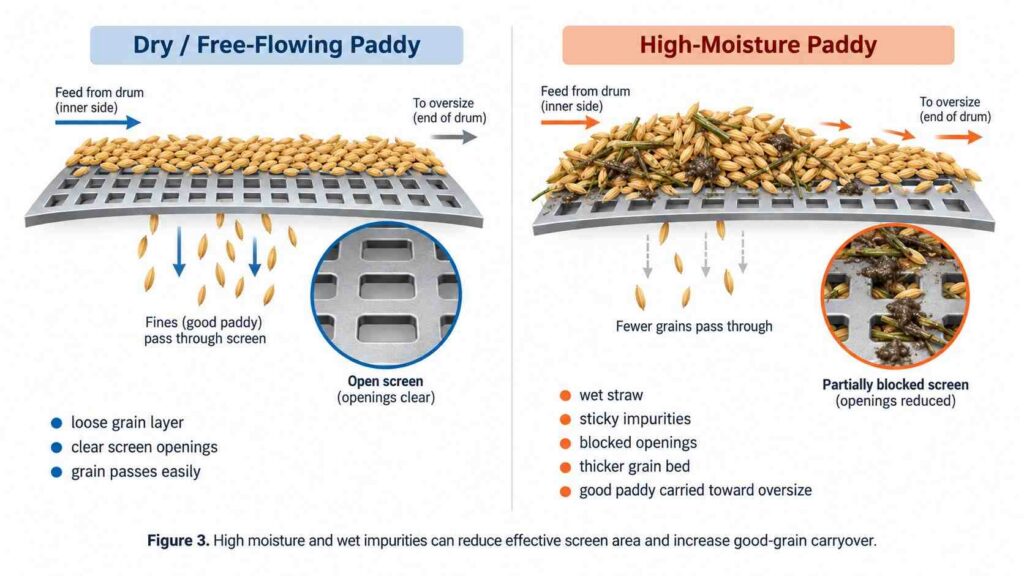
Wet fibrous material can stick to the screen or bridge across the openings, while sticky mud may attach to the paddy, straw, and screen surface at the same time. As the effective open area decreases, fewer good kernels can pass through the screen, increasing the risk of screen blockage and good-grain carryover toward the oversize outlet.
The result can be lower effective capacity and reduced cleaning efficiency. For this reason, a pre-cleaner rated at 100 TPH on dry wheat should not automatically be expected to handle 100 TPH of wet paddy at 22–25% moisture with the same result.
Pre-cleaning before drying is still important. IRRI notes that fines can restrict airflow in the dryer, while straw and immature material can increase drying time and energy use. See IRRI guidance on heated-air drying and pre-cleaning for further reference.
Pre-Cleaning Before Paddy Drying Has a Different Goal
Wet paddy still needs pre-cleaning before drying, but the target should be realistic. At this stage, the priority is to remove material that can interfere with the dryer or downstream handling system, including long straw, stalks, large foreign material, excessive fines, and part of the light impurities. The aim is not to achieve final rice-cleaning quality before drying.
Impurity Load and Impurity Condition
The percentage of impurities matters, but their physical condition can have an even greater effect on screening performance. Five percent of dry, loose straw does not behave like the same amount of wet, tangled straw, and even a small amount of sticky mud can cause more screen blockage than a much larger quantity of dry fines.
For difficult materials, photos, videos, representative samples, moisture data, and the approximate size of the largest impurities often provide a more reliable basis for machine selection than impurity percentage alone.
How to Select a Rotary Drum Pre-Cleaner
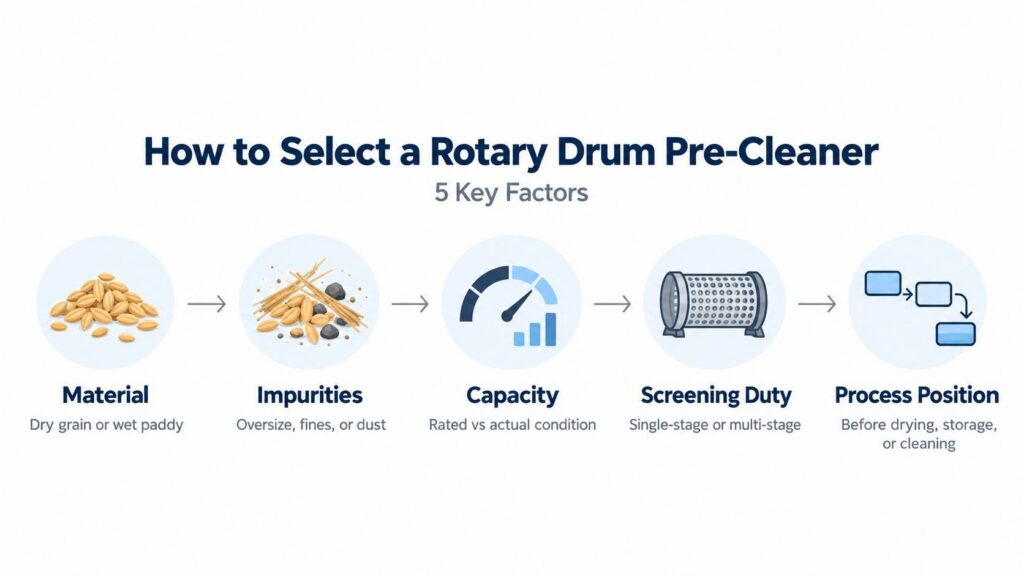
Machine selection should start from the actual material, separation target, and process position rather than from a capacity number alone. A machine that works well for dry, free-flowing grain may perform very differently with wet material, heavy impurities, or a more demanding separation duty.
Start With the Main Separation Target
The first step is to define what actually needs to be removed. If the main problem is long straw, sticks, cobs, leaves, or other oversized material, a rotary drum pre-cleaner is often a good fit. If the remaining impurities are mainly stones close to the grain in size, low-density defective kernels, or color defects, another cleaning stage will usually be required. This keeps each machine focused on the separation it is designed to perform.
Check Capacity Against the Real Operating Condition
Nominal capacity should be treated as a reference condition rather than a universal value. Bulk density, moisture, impurity load, and material flowability all affect actual throughput, so lighter, wetter, dirtier, or less free-flowing material may require additional capacity margin compared with the grain used for the original machine rating.
Choose the Screen Configuration
If the main duty is only to remove coarse oversize material, one screening stage may be sufficient. Where both oversized and smaller impurities need to be separated, a double-drum or multi-stage configuration may be more suitable. When the size difference between the grain and impurities is small, screen selection is better confirmed with a representative sample rather than assumptions alone.
Plan Dust Collection With the Pre-Cleaner
Dust collection should be considered together with machine capacity and installation conditions. In high-dust receiving lines, the extraction air volume, ducting, cyclone, and pulse bag dust collector should be sized as one system rather than added after the pre-cleaner has already been selected. This becomes increasingly important as receiving capacity and dust load rise.
Consider Where the Pre-Cleaner Sits in the Process
The required cleaning duty changes with the process position. Before drying, the priority is usually to remove material that can disturb airflow, block equipment, or increase dryer load. Before storage, the focus is keeping coarse field impurities out of the silo system, while a pre-cleaner ahead of fine cleaning or milling mainly reduces the load on more selective downstream equipment. Defining this position early makes the machine configuration easier to confirm.
Use Real Material Information for Difficult Applications
For standard dry grain, a clear material description and capacity requirement may be enough for a preliminary selection. For wet grain, unusual impurities, or difficult screening conditions, photos and videos usually provide a more reliable picture of actual material behavior, while a representative sample is especially useful when screen size or achievable capacity is uncertain.
Frequently Asked Questions
Can a rotary drum pre-cleaner remove both large and small impurities?
Yes, if the machine is designed with more than one screening stage. One section can remove oversized material such as straw, sticks, and cobs, while another can separate smaller impurities. The actual separation depends on the drum design and screen openings.
Is a double-drum pre-cleaner always better than a single-drum design?
No. A double-drum design is useful when more than one size-based separation is needed. If the main task is only to remove large impurities, a simpler single-drum design may already be sufficient.
Should pre-cleaning capacity match the dryer capacity exactly?
Not necessarily. The required margin depends on receiving peaks, moisture, impurity load, flowability, and how continuously the dryer is fed. Wet or difficult-flowing grain usually needs more conservative sizing than dry grain.
Can a rotary drum pre-cleaner be used at different receiving sites?
Yes. A mobile rotary drum pre-cleaner can be used where grain receiving or pre-cleaning moves between different locations. The machine can be mounted on a mobile frame and combined with feeding, conveying, and dust collection equipment as needed. This is useful for seasonal collection, temporary receiving points, farms, and other locations where a fixed installation is not necessary.
Conclusion
A rotary drum pre-cleaner works best when the machine is matched to the actual material condition, separation duty, and process position rather than selected from nominal capacity alone. Screen configuration, feed condition, moisture, impurity load, and dust handling all affect the final cleaning result and usable throughput. For difficult materials such as wet paddy or grain with sticky or heavy impurities, additional capacity margin or a different cleaning arrangement may be needed. The next step is to confirm the real material condition and process requirements before finalizing the machine size and configuration.
Need Help Selecting the Right Rotary Drum Pre-Cleaner?
With more than 30 years of grain-cleaning experience behind our equipment development, Shangke Machinery designs rotary drum pre-cleaners and complete grain receiving and cleaning systems for different crops, capacities, and impurity conditions. We also support machine selection with material analysis, screen configuration, dust collection planning, and process layout.
You can view our rotary drum pre-cleaner or contact our team with your material, required capacity, moisture, main impurities, and available site information for a more specific recommendation.